The History of the Bandana: Journey of a Symbol, from Ancient Craft to Contemporary Icon
Maxime GuengantThe bandana is a textile paradox: a simple square of fabric, yet imbued with a history that spans continents, social classes, revolutions, and cultural movements. You'll find it around cowboys' necks, in bohemian artists' hair, in musicians' back pockets, on political posters, in workshops, fields, and streets. It is both utilitarian and symbolic, popular and sophisticated, discreet and assertive. To understand why this small cotton square has become an icon, we must go back to its origins, long before fashion, long before Hollywood, long before pop culture.

Explore our bandana collection
1. At the Roots: A Textile Art Born in India
The word "bandana" comes from the Hindi bāndhnū or bandhnu, meaning "to tie, to bind." It refers to a resist-dyeing technique, bandhani, practiced for centuries in northwestern India, particularly in Rajasthan and Gujarat.
The principle seems simple, but its finesse is incredible: the fabric is tied in hundreds of small points, then dipped in dye baths. The tied areas remain lighter, creating delicate, almost vibrant patterns. Each color, each motif, each combination carries a meaning: celebration, marriage, protection, spirituality. These fabrics are not mere cloths: they are fragments of culture, rituals, and transmission.
When European trading companies began importing these fabrics in the 18th century, they immediately fascinated. The colors were intense, the patterns lively, the material light. Very quickly, these dyed and printed squares became accessories worn as much for their beauty as for their utility.
2. From India to Europe: An Exotic Object That Seduced All Circles
In the 18th and early 19th centuries, printed Indian fabrics — the famous indiennes — enjoyed immense success in Europe. Bandanas, with their floral, geometric, or Kashmir shawl-inspired motifs, became prized objects. They were used as handkerchiefs, scarves, and head accessories. They circulated among all social classes: from merchants to artisans, from bourgeois to sailors.
Very quickly, Europe began to produce its own bandanas. In Mulhouse, France, dyers developed a version of the famous "Turkey red," a deep red dye that became emblematic of the classic bandana. The process was so complex — a mixture of madder root, oil, salts, sometimes even sheep manure — that it sparked genuine industrial espionage stories at the time.
The bandana thus became a hybrid object: both a descendant of Indian craftsmanship and a product of the European textile industry.
3. The 19th Century: The Accessory of Workers, Pioneers, and Cowboys
In the United States, the bandana changed status. It became the ally of workers, farmers, miners, and cowboys. In fields, mines, and workshops, it protected from the sun, dust, and smoke. It served as an improvised mask, filter, and protection. It was used to wipe sweat, cover the face, tie tools, and signal something from a distance.
In the collective imagination, the red or blue bandana tied around a cowboy's neck has become an iconic image. But behind this image lies a very simple reality: it was a survival tool, a robust, versatile, inexpensive piece of fabric. A companion on the road, more than a style accessory.

Explore our bandana collection
4. The Bandana as a Political Medium and Symbol of Freedom
What is less known is the bandana's role in political history. From the late 18th century, some bandanas were printed with portraits, slogans, and maps. During the American Revolution, for example, bandanas depicted George Washington on horseback, surrounded by cannons and patriotic mottos. They were also found in 20th-century election campaigns, with candidates' faces and political messages.
The bandana then became a communication medium: it was worn, displayed, and shown. It was both textile and manifesto. It circulated in crowds, in meetings, in the streets. It became a small personal flag, a sign of allegiance, a symbol of freedom.
5. Subcultures, Music, and Identities: The Bandana as a Code
From the 1970s onwards, the bandana fully entered the language of subcultures. It was found among hippies, bikers, punks, rockers, then in hip-hop, skateboarding, certain LGBT communities, gangs, and alternative scenes.
It became a code: the color, the way it was worn, where it was tied could signify belonging, an attitude, a demand. On stage, it accompanied musicians, singers, and performers. In the street, it became a sign of style, sometimes of resistance, sometimes of provocation.
What's fascinating is that the bandana remains the same object — a printed cotton square — but changes meaning depending on the context. It can be a symbol of work, struggle, marginality, celebration, community, danger, or freedom.
6. Today: A Universal Accessory, A Detail That Tells A Story
Today, the bandana is everywhere. We see it in fashion, decoration, editorial shoots, festivals, and everyday looks. It has become a unisex, timeless accessory that spans generations. It is worn around the neck, in the hair, on the wrist, on a bag, in a back pocket, tied to a belt or a handle.
Its strength is its simplicity: a square of fabric that can say everything or almost nothing, depending on how it is worn. It can be discreet, almost invisible, or, on the contrary, become the focal point of an outfit. It can evoke America, India, Provence, the road, the stage, the workshop, the beach. It is both highly coded and completely free.
 Explore our bandana collection
7. The SouldlroW Bandana: Continuing a Story, Making It a Talisman
At SouldlroW, I don't see the bandana as a mere "trendy" accessory.
I see it as an object of continuity: a link between ancient craftsmanship, popular imaginaries, and a contemporary way of expressing oneself through what one wears.
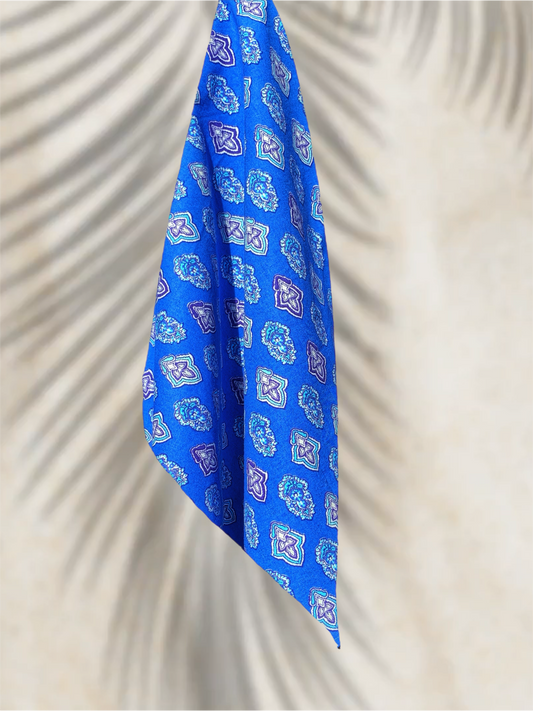
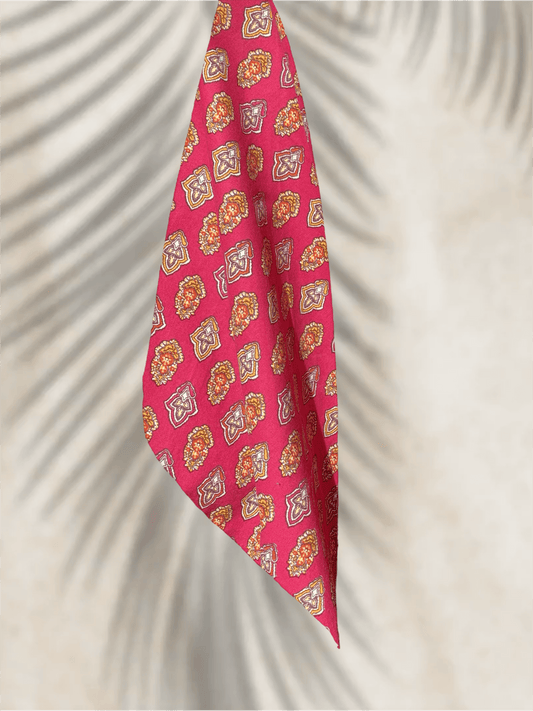
My bandanas are made in France, in small series, from carefully chosen fabrics, inspired by Provençal indiennes and revisited traditional motifs. Each piece is designed as a talisman: a square of fabric that carries a color, a memory, a vibration. An object that one ties around oneself as one would tie an intention.
What interests me is not just the style, but the gesture: the moment one chooses a bandana, folds it, ties it. This gesture repeats, in its own way, thousands of other gestures before it: those of Indian artisans, workers, cowboys, artists, anonymous individuals. Wearing a bandana means entering into this history, extending it, reinterpreting it.
Conclusion: A Square of Fabric, Centuries of Symbols
The history of the bandana shows how a simple object can become a powerful cultural symbol. Born in Indian dyeing workshops, passing through European ports, American plains, concert stages, and social movements, it continues today to live around our necks, in our hair, on our bags.
At SouldlroW, I choose to honor it as it deserves: by respecting its heritage, by valuing craftsmanship, by transforming it into an everyday companion — a small piece of fabric that tells much more than it seems.